Shoulders Up: What Collective Tension Carved Into the American Body

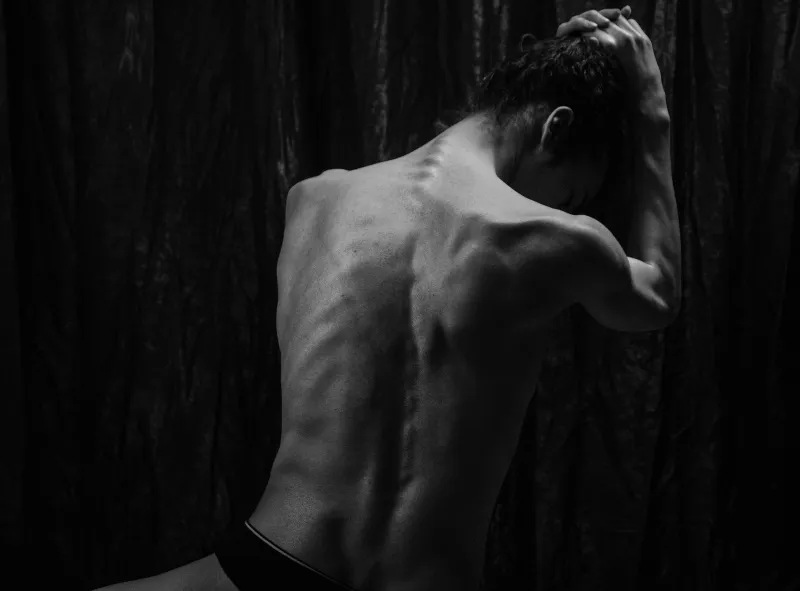
Photo: person tense shoulders stress posture urban American, via img.freepik.com
There's a shape that keeps showing up on massage tables, in physical therapy offices, in yoga studios from Portland to Atlanta. Shoulders hiked toward the ears. Chest caved inward. The upper back rounded like a question mark that forgot it ever expected an answer. Practitioners who work with bodies for a living aren't just seeing it occasionally — they're seeing it constantly, across age groups, across income brackets, across the country.
It's tempting to chalk this up to screens. And sure, screens are part of it. But the people who spend their days reading bodies say the story is bigger than that. What's happening in the American shoulder isn't just a tech posture problem. It's a cultural one.
The Body Keeps the Score — and the Stress
Anxiety doesn't live only in the mind. It sets up shop in the body, picks a neighborhood, and starts paying rent. For a lot of Americans, that neighborhood is the upper trapezius — the thick band of muscle running from the base of the skull down to the shoulder blades. When the nervous system registers threat, those muscles brace. When the threat never fully resolves, they stay braced. For hours. For days. Eventually, for years.
Somatic practitioners describe this as "armoring" — a term borrowed from the work of Wilhelm Reich, who argued decades ago that unresolved emotional experience gets locked into muscular patterns. The body, in other words, doesn't forget what the mind tries to move past. It just holds it differently.
What's striking right now is how collective that holding has become. Therapists and bodyworkers who've been in practice for twenty or thirty years will tell you the tension they're encountering today has a different quality than what they saw even a decade ago. It's not just the stress of individual lives — it's something ambient, something that seems to come from being alive in America at this particular moment.
When the Whole Room Is Braced
Think about the last time you were in a public space — a waiting room, a subway car, a coffee shop. Look at the shoulders around you. Not as a judgment, but as data. How many people are carrying their upper body like they're expecting something to fall? How many are physically contracted in the direction of their phones, their laps, their own chests?
This is the posture of low-grade, chronic vigilance. It's not the dramatic flinch of sudden fear — it's the slow compression of a body that's been on alert for so long it's stopped registering the alarm. The nervous system has essentially normalized a state of readiness that was never meant to be permanent.
Physical therapists call the resulting pattern "upper crossed syndrome" — a clinical term for the specific imbalance where the chest tightens, the upper back rounds, the deep neck flexors weaken, and the shoulder blades lose their anchor. It's extremely common. It's also, increasingly, something practitioners are framing less as a biomechanical malfunction and more as a physiological response to environment.
The environment, in this case, being America.
The Decade-by-Decade Drift
Posture isn't static across history. Movement educators point out that the shapes bodies default to shift in response to the demands — physical and psychological — of their era. Industrial labor produced one set of patterns. Office work produced another. The smartphone era introduced a forward head position so prevalent it got its own nickname: "tech neck."
But there's a layer beneath the ergonomic. The 2000s brought a particular kind of collective dread — the post-9/11 security state, the 2008 financial collapse, the sense that stability was something you could no longer assume. The 2010s layered on social media anxiety, political polarization, and an always-on information environment that made it nearly impossible to fully exhale. The early 2020s, with a pandemic and the collapse of several shared social narratives simultaneously, pushed the physiological dial even further.
Each of these moments left something in the body. Not metaphorically — literally. Stress hormones shape muscle tone. Chronic sympathetic nervous system activation reshapes posture over time. The American body has been accumulating these deposits for decades, and the shoulders are where a lot of that accumulation is most visible.
What Awareness Actually Does
Here's the part that matters: noticing isn't nothing. Somatic practitioners are emphatic on this point. The moment you become aware that your shoulders are up around your ears is the moment you have the option to let them drop. That sounds simple, almost embarrassingly so — but the gap between unconscious bracing and conscious choice is genuinely significant.
This isn't about fixing your posture in the aesthetic, stand-up-straight sense. It's about interrupting the feedback loop. When the body holds a shape of anxiety long enough, it starts to generate the feeling of anxiety even when the original trigger is gone. The posture becomes the message the nervous system keeps sending itself. Releasing the shape — even briefly, even imperfectly — gives the system a different signal to work with.
Somatic movement teachers often describe this as "completing the cycle." The body braced for something. That something is over, or at least it's not actively happening right now. The brace can release. The breath can go somewhere other than the top of the chest. The shoulders can find the back pockets instead of the earlobes.
None of this is a cure for the conditions that produced the tension. The news cycle will still be the news cycle. The financial precarity, the political noise, the ambient sense that something is always about to go wrong — those aren't resolved by a shoulder roll. But the body's relationship to that reality is not fixed. It's malleable. And that malleability is where agency lives.
The Story Your Posture Is Telling
At Incarne, we keep coming back to the idea that the body is where culture writes itself in real time. Not on screens, not in trend reports — in muscle and bone and breath. The American shoulder, hunched and held, is doing a kind of storytelling right now. It's narrating a collective experience of sustained uncertainty, of a nervous system that's been asked to manage more than nervous systems were designed to hold.
The question isn't whether that story is true. It clearly is. The question is whether it has to be the only story the body gets to tell.
Let them drop. Not because everything is fine. But because the body deserves the chance to feel what it's like when the armor comes off — even for a minute, even in a coffee shop, even now.