Touch and Go: What Happens in Your Body the Moment Before You Decide How to Say Hello
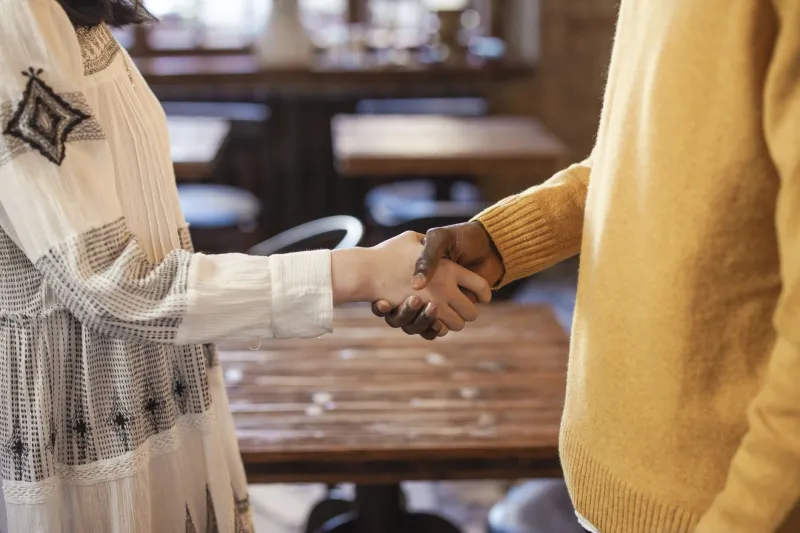
You know the moment. You're walking toward someone — a colleague, a distant friend, a first date — and somewhere around the six-foot mark, your brain starts doing math your body doesn't have an answer for. Hand out? Elbow? Fist? Hug? That little flash of uncertainty, the split-second recalibration, the almost-reach that turns into something else entirely — that's not awkwardness. That's your body trying to speak a language that got rewritten mid-sentence.
The handshake, as Americans knew it, is in a weird limbo. It's not fully dead. But it's not fully alive either. And what's happening in that gap — in the hesitation, the misread signal, the mutual flinch — says more about our collective interior life than almost anything else we do in public.
The Grip That Used to Mean Everything
For most of American professional and social history, the handshake carried enormous symbolic weight. Firm grip, eye contact, one or two pumps — done. You'd communicated confidence, respect, reliability, and intent all in about 1.5 seconds. It was a body-language shorthand so deeply embedded in the culture that entire industries built training programs around it. Coaches, consultants, and HR departments spent real money teaching people to shake hands like they meant it.
That's a lot of meaning to load onto a palm-to-palm touch. Which is maybe why, once that touch became genuinely risky for a couple of years, the whole structure wobbled. COVID didn't just make us stop shaking hands — it made us think about why we were doing it in the first place. And once you start interrogating a ritual that deeply, it's hard to go back to performing it without awareness.
The grip hasn't disappeared. But the automatic quality of it has. And that's actually where it gets interesting.
What the Hesitation Is Actually Saying
Sports psychologists and somatic therapists talk a lot about the body's role in social negotiation — the way physical space and contact aren't just logistics but are actually communication. When you pause before offering your hand, your body is broadcasting something. When you extend and then pull back slightly, reading the other person's energy, you're engaging in a micro-negotiation that has emotional content.
That hesitation? It's not weakness. It's actually a kind of honesty. You're not performing certainty you don't have. You're acknowledging that the social contract around touch is genuinely unsettled right now, and your nervous system knows it even if your professional brain is trying to override it.
Some people interpret that pause as anxiety. And sure, sometimes it is — pandemic-era hypervigilance left real marks on how a lot of Americans relate to physical contact. But read differently, the hesitation is also a moment of genuine presence. You're actually there, actually reading the room, actually paying attention to the other person rather than running a memorized script.
The Alternatives We're Reaching For
Watch what people are doing instead, and you start to see something kind of beautiful. The fist bump, once reserved for athletes and close friends, migrated into boardrooms and first meetings. The elbow tap became a pandemic-era joke that somehow stuck. The nod — that ancient, low-stakes acknowledgment — made a comeback in spaces where people were still figuring out the rules.
And then there's the hug. Here's the strange thing: in some contexts, Americans have leaned into physical warmth rather than away from it. Particularly in younger demographics and more progressive social spaces, the full embrace has replaced the handshake for first meetings in a way that would've felt presumptuous a decade ago. There's an argument that when formal touch got stripped away, some people responded by reaching for something more genuine.
None of these replacements are universal. That's the point. We're in a pluralistic moment for physical greeting, and the negotiation itself has become part of the encounter.
Reading the Room Has Become a Full-Body Exercise
What's changed isn't just what we do — it's the attention we're bringing to it. Pre-pandemic, most people weren't consciously thinking about how they greeted someone. The handshake happened on autopilot, and if you thought about it at all, it was in terms of technique. Now, there's an active scanning process happening. You're reading posture, eye contact, proximity, energy. You're asking the room a question with your body before your mouth opens.
This is, in a very real sense, a form of performance literacy. The kind of attunement that performers, dancers, and actors spend years developing — reading a partner's body, responding in real time, staying present to what's actually happening rather than what's supposed to happen — is now something ordinary people are doing at networking events and family dinners.
It's uncomfortable, yes. But discomfort is often what growth feels like before you've named it.
The Freedom Inside the Uncertainty
Here's the reframe that might actually matter: the collapse of a universal greeting ritual isn't a social failure. It might be an opening.
The handshake was never neutral. It was a Western, historically masculine, professional-class default that got universalized in American culture in ways that erased a lot of other traditions. Plenty of cultures greet with bows, cheek kisses, hand-to-heart gestures, or simple verbal acknowledgment — forms of connection that carry their own richness. The rigid handshake norm crowded those out, at least in formal American contexts.
When that norm loosened, something else got to breathe. The moment of uncertainty before a greeting is also a moment of choice — a chance to actually meet the person in front of you rather than just execute a protocol. It's an invitation to be present in your body, to read and respond, to let the greeting mean something because you chose it rather than defaulted to it.
That's not nothing. That's actually kind of everything.
What Your Body Knows That Your Etiquette Book Doesn't
The people who navigate the new greeting landscape best aren't the ones who've picked a new default and are executing it confidently. They're the ones who've gotten comfortable in the uncertainty itself — who can let that pause exist without filling it with performance, who can read a situation and respond genuinely rather than mechanically.
Your body already knows how to do this. It's been reading other bodies your whole life. What's different now is that you're being asked to trust that knowledge instead of overriding it with a script.
So the next time you're walking toward someone and you feel that split-second of not knowing — don't rush past it. Let it be information. Let your body actually say hello.
That moment of honest uncertainty might be the most real thing about the whole encounter.