Folding Inward: What Shame Does to the American Body When No One Is Watching

Photo: Cynthia Magana cynthmag, CC0, via Wikimedia Commons
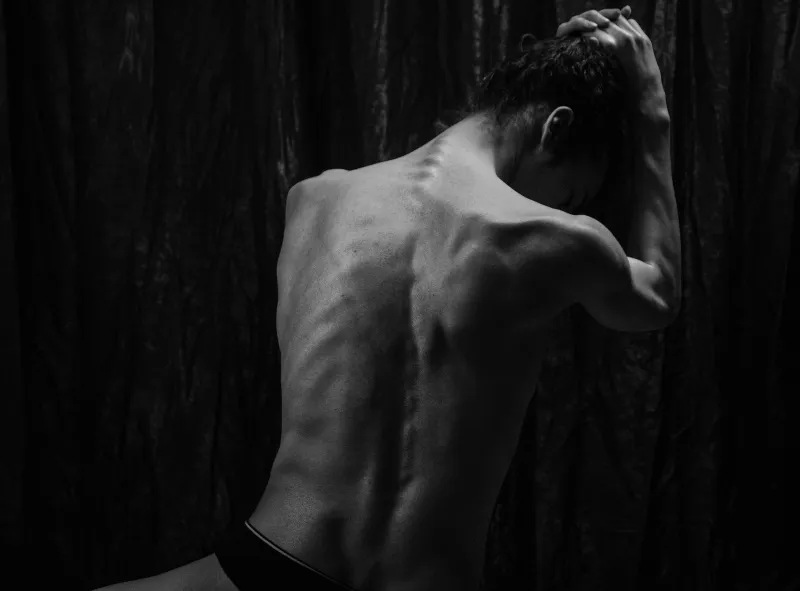
There's a posture most of us know intimately, even if we've never named it. It happens alone — in the bathroom after a hard conversation, in the car after a job interview that went sideways, in bed at 2 a.m. staring at a ceiling that offers nothing back. The chest caves slightly. The shoulders round forward. The chin dips. The whole upper body makes a slow, quiet decision to take up less space.
Nobody taught you that posture. Nobody had to. Shame is one of the oldest choreographers the human body has ever known.
The Shape of Something You Never Said Out Loud
Physical anthropologists have documented shame postures across cultures for decades, but what makes the American version particularly interesting is how much of it runs on autopilot. We're a culture that prizes confidence, projection, the open handshake and the steady eye contact. And yet, underneath all of that performed assurance, the body is often running a very different program.
Somatic therapists — practitioners who work at the intersection of body and psychological experience — describe shame as one of the most physically organizing emotions a person can carry. Unlike fear, which tends to spike and release, shame is chronic. It settles. It becomes architectural. The hunched shoulders aren't just a reaction to a single bad moment; they're the accumulated weight of every moment you decided you were too much, not enough, or simply wrong for the room.
Over time, that architecture becomes load-bearing. The fascia — the connective tissue that wraps around muscles and organs — actually adapts to the shapes we hold most frequently. A body that spends years in protective collapse begins to structurally reinforce that collapse. The muscles along the upper back lengthen and weaken. The chest muscles shorten. The neck juts forward. What started as an emotional reflex becomes a skeletal fact.
Perfectionism as a Physical Project
America has a specific relationship with shame that makes this particularly potent. We are, broadly speaking, a culture obsessed with self-improvement, productivity, and the performance of having it together. The gap between who we're supposed to be and who we actually are is enormous — and we feel that gap in the body, not just the brain.
Researchers at the University of California have found that self-critical thinking activates the same threat-response systems as external danger. The body doesn't easily distinguish between a predator and an inner critic. When you sit alone replaying a conversation you handled badly, your nervous system is, in some meaningful sense, bracing for impact. The shoulders rise. The breath shallows. The torso curls around its own center like it's guarding something vital.
For a lot of Americans, that response fires dozens of times a day. The culture of perfectionism means there's always a new standard to fall short of, always a new version of yourself that hasn't quite arrived yet. The body keeps the score, as the saying goes — but it also keeps the shape.
What We Do When We Think We're Alone
Here's what's revealing: shame postures intensify in private. In public, social pressure often counteracts the collapse — we stand taller, make ourselves readable, perform the version of ourselves we want the world to see. But strip away the audience, and the body tends to revert.
Watch someone reading a message that embarrasses them. Watch someone catch their reflection unexpectedly and look away. Watch someone in the instant after they've said something they immediately regret. The body responds before the mind has finished processing. The shrink is involuntary. The folding-in is reflexive.
This is what makes shame so different from other uncomfortable emotions. Anger opens the body — chest out, jaw forward, limbs ready. Sadness releases it — tears, trembling, the physical undoing of held tension. But shame closes. It compresses. It is, at its core, a physical argument for your own smallness.
The Politics of Taking Up Space
It's worth noting that shame doesn't land equally across American bodies. Research consistently shows that people from marginalized communities — those navigating racism, fatphobia, ableism, queer identity in hostile environments — carry disproportionate loads of chronic shame-based stress. The body that has been told repeatedly, through culture and policy and interpersonal cruelty, that it is too visible in the wrong ways, learns to shrink strategically. That shrinking can be protective. It can also be quietly devastating over time.
This is where the conversation about posture stops being about ergonomics and starts being about freedom. Reclaiming an open body — shoulders dropped and back, chest unguarded, gaze level — isn't just a wellness tip. For a lot of people, it's an act of defiance against a culture that trained them to make themselves smaller.
Body-based practitioners like yoga therapists, somatic experiencing facilitators, and trauma-informed movement coaches are increasingly framing their work in exactly these terms. Opening the chest isn't just a stretch. It's a renegotiation with every message — internal and external — that told you to close.
What Unfolding Actually Feels Like
People who do this work often describe the same thing: expanding the body feels vulnerable before it feels good. Lifting the sternum, releasing the shoulders back, taking a full breath into the front of the ribs — all of it can trigger a wave of emotion that catches people completely off guard. Because the posture was protecting something. And when the protection lifts, whatever was underneath it gets to move.
That's not a malfunction. That's the body doing exactly what it's designed to do — process, release, reorganize. The tears that come when someone finally lets their shoulders drop aren't weakness. They're the physical exhale of something that's been held way too long.
The most radical thing you might do today isn't a productivity hack or a mindset shift. It might just be this: sit somewhere quiet, alone, and let your chest open. Not for anyone watching. Not to look more confident or take up more space in some social transaction. Just to see what your body does when you stop asking it to protect you from yourself.
The posture of shame is a story your body has been telling. The question is whether you're ready to let it end.