Dressed for Duty: How the Clothes You Wear to Work Reprogram Your Body Before You Even Clock In
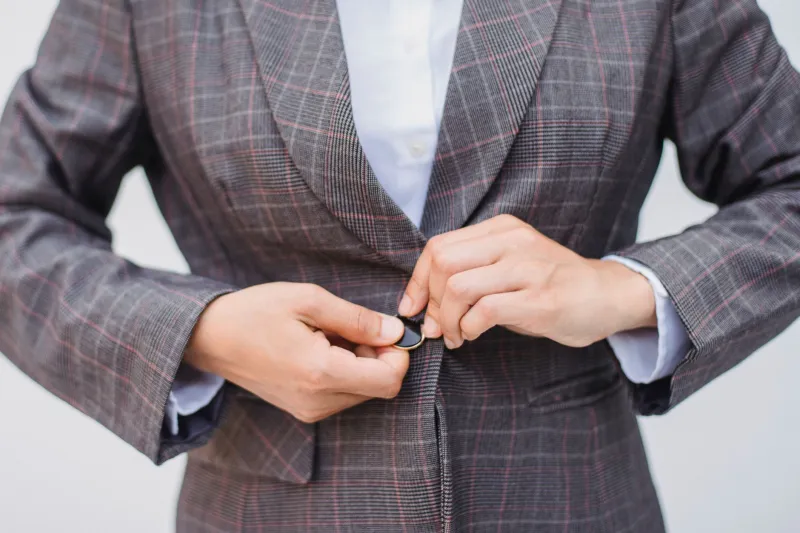
There's a moment most working Americans know intimately but rarely name. You're standing in your bedroom, still half-asleep, and you pull on the blazer. Or you knot the tie. Or you tuck the button-down so far into the waistband that breathing becomes a negotiation. And something shifts. Not just in the mirror—inside you. Your jaw sets a little differently. Your shoulders find a new address, slightly higher, slightly back. The person staring back at you is not exactly the person who woke up ten minutes ago.
That transformation isn't metaphorical. It's neurological.
The Science of Getting Dressed
Researchers have been poking at this phenomenon for over a decade, and what they've found is genuinely strange. The term enclothed cognition—coined by psychologists Hajo Adam and Adam Galinsky in a 2012 study—describes how the symbolic meaning and physical experience of wearing certain clothes actually changes cognitive performance and emotional state. Participants who wore a lab coat described as a doctor's coat showed measurably higher attention and focus than those wearing the same coat described as a painter's smock. Same garment. Different story. Different body.
But professional dress goes further than cognition. It reaches into the body's motor patterns and autonomic functions. A collar that sits snug against the throat activates the vagus nerve differently than an open neckline. Compression at the waist—from a structured skirt, a tucked shirt, a fitted suit—alters diaphragmatic breathing. You breathe shallower. Your body reads that shallowness as mild stress. Mild stress triggers a low-grade cortisol response. And you haven't even had your coffee yet.
This isn't a bug in the system. For many workplaces, it's the feature.
The Costume Has a History
Professional dress codes in America didn't emerge from some neutral desire for order. They evolved as mechanisms of social sorting and behavioral control, and the body was always the site of enforcement. The starched collar of the nineteenth century office worker literally held the head upright, restricting lateral movement and encouraging a posture that read as attentive, contained, and deferential. The corset—never entirely absent from women's professional dress even as its form evolved—compressed not just the waist but the very act of speaking loudly, laughing freely, or taking a full breath.
Think about what that means for performance. The stage directions were written into the fabric.
Modern equivalents are subtler but no less effective. The structured blazer limits arm range of motion. High heels shift the pelvis forward and shorten the Achilles tendon, literally changing how a person moves through a room—smaller steps, less ground coverage, a gait that reads as careful rather than purposeful. The standard men's suit, with its padded shoulders and tapered waist, is essentially a prosthetic of authority. It builds the body it wants you to inhabit.
What the Body Is Actually Doing
Here's where it gets interesting from a performance standpoint. Actors and dancers have long understood that costume precedes character. Put someone in a corset and they'll stand differently. Hand them a crown and watch their chin lift. The clothes aren't just reflecting an identity—they're generating one, recruiting the body's proprioceptive system to fill in the role.
For most American workers, this recruitment happens unconsciously every single morning. The physical act of dressing for work is a rehearsal. A warm-up. A way of summoning a version of yourself that the workplace has decided it needs. Your nervous system learns the part so well it can perform it in its sleep—or rather, before you're fully awake.
Occupational therapists and somatic practitioners have started paying real attention to what this daily performance costs. Chronic neck tension in office workers is often traced not to desk ergonomics alone but to the combined effect of collar height, screen position, and the habitual jaw-clenching that comes with professional performance anxiety. The body is holding the role all day, and holding is exhausting.
The Undressing
Ask anyone what they do the moment they get home from work and the answer is almost universal: they change their clothes. Immediately. Before they check the mail, before they feed the cat, before they do anything else. The shoes come off. The waistband loosens. The collar opens.
The relief is physical and it's real. What's happening is a measurable shift in autonomic state—the parasympathetic nervous system getting a little more room to operate. Muscles that have been subtly braced all day release. Breathing deepens. The body begins to remember a different version of itself.
Some people describe this transition as the best moment of their day, which is worth sitting with. The single most satisfying physical experience for millions of Americans is simply being allowed to return to their own body.
Reclaiming the Ritual
None of this means you should show up to your next quarterly review in sweatpants—though honestly, the pandemic years did some fascinating damage to that particular social contract. What it means is that the morning dressing ritual deserves a little more conscious attention than we typically give it.
Some somatic coaches and body-oriented therapists are starting to reframe the act of getting dressed as an opportunity rather than an obligation. What does it feel like to choose a garment that allows full breath? To notice where restriction lives in the body before you leave the house? To dress in a way that performs professionalism without fully surrendering physical autonomy?
These aren't small questions. The costume you wear every day is shaping your nervous system, your posture, your breath, and your sense of self—five days a week, for decades. That's not just fashion. That's embodiment. That's the body becoming the story the workplace wants to tell.
The least we can do is know we're performing it.