No Mic Needed: How Performers Without Voices Are Owning the Stage
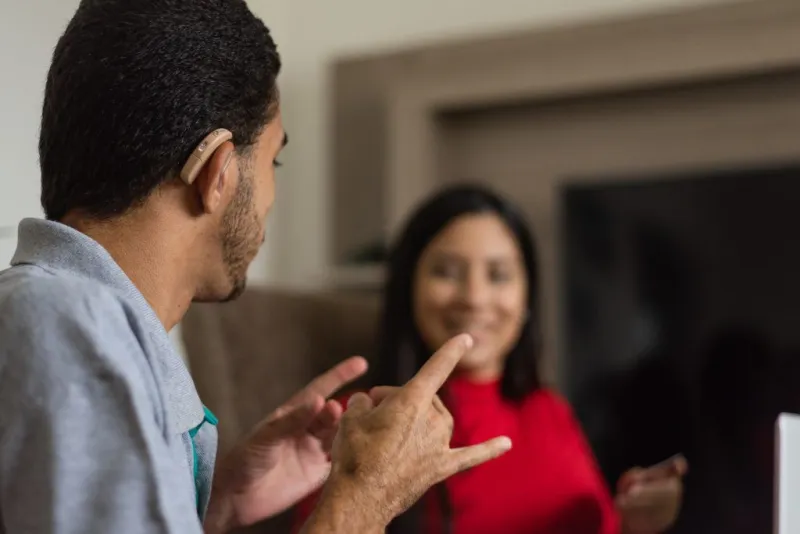
Photo: deaf ASL performer on stage expressive hands spotlight, via i.pinimg.com
There's a moment at a Deaf Rave event — if you've never been to one, find one — where the bass hits the floor and the room moves as a single organism. No one is waiting for lyrics to lead them. No one needs a voice to feel the story being told. The performers at the front aren't interpreters in the background. They're the show.
For a long time, the entertainment industry treated vocal ability as the price of admission. You sang, you spoke, you narrated your own experience in words that fit neatly into a microphone. Everyone else was a supporting act. But something has shifted — quietly at first, then all at once — and the people who were supposed to be on the margins are now standing center stage, completely unbothered.
The ASL Artists Who Became the Main Event
Most people discovered sign language performance through concert interpreters. You'd see them at the edge of the stage, hands flying, and if you were paying attention, you'd notice something strange: sometimes they were more compelling to watch than the artist they were translating. That wasn't an accident.
Sign language — American Sign Language in particular — is not a visual transcript of English. It's its own complete language, with its own grammar, rhythm, and poetry. When a skilled ASL artist performs, they aren't converting words into gestures. They're composing. Interpreters like Amber Galloway Gallego became viral sensations not because they were helpful accommodations but because their performances were electric. The way she rendered the bass drops in hip-hop tracks, the way her whole body became a percussion instrument — audiences who had never thought twice about accessibility suddenly couldn't look away.
Now a younger generation is taking that energy further. Deaf performers are building careers entirely on their own terms, not as translators of hearing culture but as originators. They're creating content on TikTok and Instagram that doesn't include captions as an afterthought — the visual language is the content. The body isn't compensating for the absence of sound. The body is the point.
Nonverbal Doesn't Mean Silent
In broader conversations about disability and performance, nonverbal autistic creators are dismantling one of the most stubborn myths in entertainment: that communication requires speech.
Creators like Jordyn Zimmerman — an autistic self-advocate who uses a tablet to communicate — have built platforms that reach hundreds of thousands of people. But it's not just the technology. It's the presence. The expressiveness. The way the body carries meaning that words, when they do appear on a screen, only confirm.
There's something almost confrontational about it, in the best possible way. So much of performance culture is built around the voice as the vessel of authenticity — the cracked note, the raw monologue, the spoken confession. When someone holds an audience rapt without any of that, it forces a reckoning. What were we actually listening for this whole time?
Movement-based artists in this space are pushing the question even harder. Choreographers and performers who communicate primarily through gesture and physical expression are crafting narratives that don't translate into language — and they're not trying to. The work lives in the body. It ends there, too. Audiences who are used to walking away with a quotable line are learning to walk away with a feeling they can't quite name, and discovering that's often the more lasting experience.
When the Stage Stops Asking for Words
The shift isn't just happening on concert stages and social media feeds. It's showing up in theater, in spoken word spaces that are quietly becoming unspoken word spaces, in comedy — yes, physical comedy is having a genuine cultural moment — and in the way live events are being designed from the ground up.
Venues and production companies that once treated accessibility as a legal checkbox are starting to realize, sometimes reluctantly, that designing for Deaf and nonverbal audiences produces better experiences for everyone. Tactile stages. Vibration floors. Visual storytelling that doesn't depend on a narrator explaining what you're seeing. These aren't accommodations. They're upgrades.
And audiences are responding. The numbers don't lie — content from Deaf and nonverbal creators consistently outperforms expectations, not because people are watching out of inspiration-porn curiosity but because the work is genuinely good. The craft is there. The intention is there. People are showing up because they want to, not because they feel they should.
Presence as a Political Act
There's a reason this moment feels charged with something beyond aesthetics. When you've spent years being told your body communicates incorrectly — too slow, too still, too much, too different — taking up space on a stage is not a neutral act. It's a statement.
For many performers in this space, the work is explicitly about reclamation. Reclaiming the idea of captivation. Reclaiming the definition of eloquence. Reclaiming the stage itself, which has historically been designed by and for people who speak in very specific ways.
That reclamation looks different depending on who's doing it. For some, it's joyful and celebratory — a Deaf DJ set that turns into a full-body dance party where no one is left out. For others, it's pointed and political — a nonverbal autistic creator who uses their platform to dismantle the medical model of disability one carefully crafted video at a time. Both are valid. Both are necessary.
What they share is a refusal to treat the voice as the only legitimate instrument of human expression. The body has always been telling stories. These performers are just making sure the room is finally paying attention.
The Audience Is Changing Too
Here's what's easy to miss in conversations about disability and performance: the audience is being transformed right along with the performers. People who grew up consuming entertainment in one very specific register — lyric-driven, dialogue-heavy, narrated — are learning to read differently. To watch differently. To feel differently.
That's not a small thing. The way we receive stories shapes the way we understand each other. When a massive TikTok audience spends three minutes genuinely transfixed by a nonverbal creator expressing something complex and true without a single spoken word, something shifts in how that audience thinks about communication, about intelligence, about what it means to be heard.
The silence speakers aren't just changing the stage. They're changing the people sitting in front of it.
And honestly? It's about time.